




Proof of Work vs Proof of Stake: A Comparison Guide
Learn the key differences between Proof of Work and Proof of Stake, including security, energy use, staking, mining, and why blockchains choose each model.

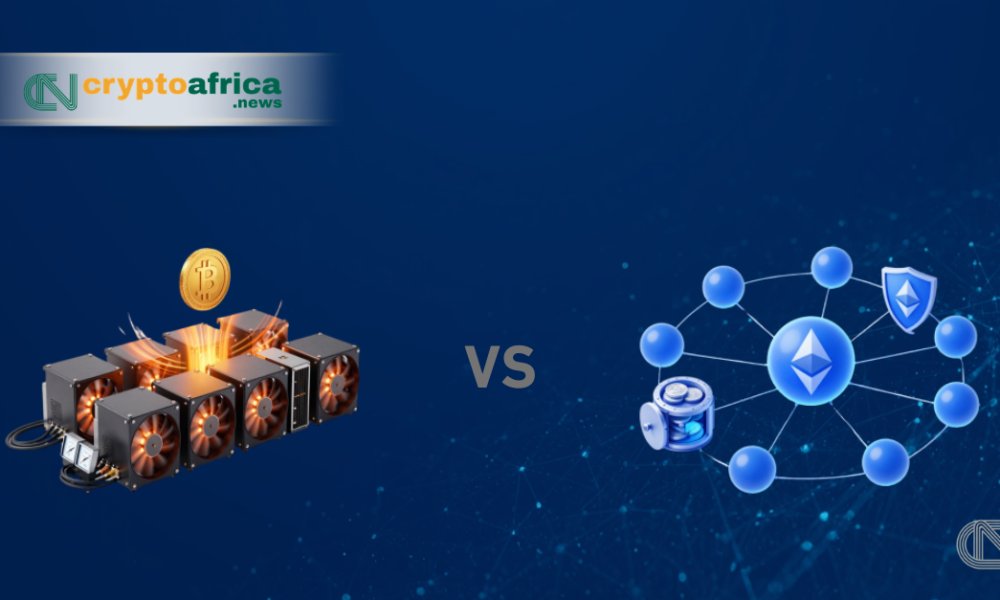
Table Of Content
Key Takeaways:
- Proof of Work (PoW) and Proof of Stake (PoS) are the two most widely used blockchain consensus mechanisms.
- Bitcoin uses Proof of Work, while Ethereum transitioned to Proof of Stake in 2022.
- Both secure blockchain networks but use very different approaches to validating transactions and adding new blocks.
- The debate isn’t about which is universally “better”; it’s about which trade-offs best suit a network’s goals.
Every blockchain faces the same fundamental problem. How do thousands of computers, run by people who don’t know each other and have no reason to trust each other, agree on what’s true?
In traditional systems, a bank or central authority solves that problem. It holds the records, processes transactions, and everyone trusts it to get things right. Blockchains were designed to remove that central authority entirely, which meant they needed an entirely different solution.
That solution is called a consensus mechanism. And the two most widely used ones, Proof of Work and Proof of Stake, are at the heart of how Bitcoin and Ethereum each work.
What Is a Consensus Mechanism?
A consensus mechanism is the set of rules a blockchain uses to get all participating computers to agree on the same version of the ledger. Without it, there’s nothing stopping someone from spending the same bitcoin twice, or from submitting fraudulent transactions that other computers would have no way to verify.
Consensus mechanisms replace the trust you’d normally place in a bank or institution. Instead of one organization certifying what’s true, the rules of the network do that work, and they do it in a way that’s extremely costly to cheat.
What Is Proof of Work?
Proof of Work is the original blockchain consensus mechanism, introduced through Bitcoin in 2009. It works through a process called mining.
When new transactions are broadcast to the Bitcoin network, miners compete to bundle those transactions into the next block. To do that, they must solve a complex mathematical puzzle. The puzzle has no shortcut: the only way to find the answer is through raw computational effort, running billions of calculations per second until one miner finds a valid solution.
The first miner to solve the puzzle earns the right to add the next block and receives a block reward, newly created Bitcoin, plus any transaction fees included in that block. Once the block is added, every other miner on the network verifies it and moves on to the next one.
The security logic behind Proof of Work is straightforward. To attack the Bitcoin network and rewrite its transaction history, you’d need to control more than half of all the computational power on the network—what’s known as a 51% attack. At Bitcoin’s current scale, that would require billions of dollars in mining hardware and electricity. The cost of an attack is so high that it makes attacking the network economically irrational.
Bitcoin still uses Proof of Work today, and its supporters consider it the most battle-tested consensus model in existence, having secured the network continuously for over fifteen years.
What Is Proof of Stake?
Proof of Stake takes a fundamentally different approach. Instead of using computational power to earn the right to validate transactions, participants lock up, or “stake” their own cryptocurrency as collateral.
Here’s an easy way to picture it.
Mining uses machines. Staking uses capital.
In a Proof of Stake system, participants who want to validate transactions become “validators” by depositing a specified amount of cryptocurrency into the network. Validators are then selected, through a combination of stake size and randomness (depending on the network), to propose new blocks and verify others’ proposals.
Honest behavior is rewarded with staking rewards. Dishonest behavior is punished through a mechanism called slashing, where a portion of a validator’s staked funds is permanently destroyed.
The economic stake itself becomes the security guarantee. Validators have a financial reason to behave honestly, because misbehaving puts their own funds at risk.
Ethereum switched from Proof of Work to Proof of Stake in September 2022 in an event known as The Merge. Solana, Cardano, Polygon, and many other major networks also use Proof of Stake variants.
Proof of Work vs Proof of Stake
| Feature | Proof of Work | Proof of Stake |
| Validation method | Mining | Staking |
| Participants | Miners | Validators |
| Energy use | High | Much lower |
| Hardware required | Specialized mining equipment | No mining hardware needed |
| Security model | Computational power | Economic stake |
| Rewards | Mining rewards | Staking rewards |
| Example networks | Bitcoin, Litecoin | Ethereum, Solana, Cardano, Polygon |
Why Does Proof of Work Consume So Much Energy?
The energy consumption of Proof of Work isn’t a bug or an oversight; it was built into the design.
Because miners compete against each other to solve the puzzle first, they’re incentivized to run their hardware continuously at full capacity. More computational power means a higher probability of finding the solution before anyone else. This competition is what creates the massive electricity demand associated with Bitcoin mining.
Specialized hardware called ASICs (application-specific integrated circuits) now dominates Bitcoin mining. These machines are built for nothing except solving Bitcoin’s puzzle as efficiently as possible, running 24 hours a day and consuming significant amounts of power.
Estimates from the Cambridge Center for Alternative Finance put Bitcoin’s annual electricity consumption in the same range as some mid-sized countries. Bitcoin proponents argue that this energy expenditure is precisely what makes the network secure. An attack is expensive because the defense is expensive.
Critics argue the environmental cost is too high relative to the benefit.
What’s not in dispute is that high energy use is a direct consequence of how Proof of Work secures the network. And it’s not a feature that can simply be removed without changing the security model entirely.
Why Did Ethereum Move to Proof of Stake?
Ethereum’s transition to Proof of Stake, completed in September 2022 after years of development, was one of the most significant technical events in crypto history. It reduced Ethereum’s energy consumption by over 99%.
The Merge, as it was called, wasn’t a signal that Proof of Work had failed. Bitcoin continues to use Proof of Work successfully. Rather, Ethereum’s developers made a deliberate choice based on where they wanted the network to go.
Ethereum’s priorities (powering smart contracts, DeFi, NFTs, stablecoins, and an increasingly complex ecosystem of applications) required a scalability roadmap that PoS made more practical to build.
Lower operating costs also made it easier for more participants to become validators compared to the capital-intensive hardware requirements of mining, which mattered for the network’s long-term decentralization goals.
The transition was years in the making and executed without disrupting the network. It demonstrated that large-scale consensus mechanism changes are possible, though the technical complexity involved means most established networks are unlikely to attempt something similar.
Security: Which Is More Secure?
This is the question most people want a clean answer to.
The honest answer is that PoW and PoS make different security assumptions, and each has genuine strengths and real challenges.
Proof of Work has been securing Bitcoin without a successful attack on its base protocol for over fifteen years. Its security model is simple and well understood. Attacking it requires enormous physical resources that don’t disappear just because an attacker becomes powerful. The computational work is the proof, and it’s verifiable by anyone.
The challenges include mining centralization. As mining has grown more competitive, it has consolidated into large mining pools and facilities with access to cheap electricity at scale. A small number of entities now control significant portions of Bitcoin’s hash rate, which raises genuine questions about how decentralised validation truly is in practice.
Proof of Stake introduces slashing, direct financial penalties for dishonest validators. This makes attacks costly in a different way: rather than burning electricity, attackers risk destroying large amounts of their own staked capital. The lower participation barrier means more people can become validators without specialized hardware.
The challenges include wealth concentration concerns. Networks where validators are selected partly based on stake size can skew influence toward those with the largest holdings. Validator centralization is also a risk if large staking pools come to dominate. Governance debates around staking decisions are ongoing in most PoS ecosystems.
The important framing here is that both mechanisms are trying to make attacks economically irrational. They just use different resources.
Which Is Better for Different Types of Blockchains?
The right consensus mechanism depends on what a network is trying to accomplish.
Bitcoin prioritizes security, stability, and immutability above everything else. A fixed rule set, a hard supply cap, and an unbroken fifteen-year security record are features, not limitations. Proof of Work fits those priorities directly.
Ethereum prioritizes smart contracts, DeFi, NFTs, tokenization, and scalability. Its roadmap requires a consensus model that can support a fast-evolving ecosystem, accommodate more validators, and work alongside Layer 2 scaling solutions. Proof of Stake fits those priorities better.
Solana prioritizes high throughput and low fees for consumer applications and payment use cases. Its Proof of Stake variant is optimized for speed above other considerations.
Consensus design isn’t a ranking of better or worse; it’s a set of trade-offs that different networks resolve differently based on their goals.
Final Thoughts
PoW and PoS are different answers to the same question: how do you secure a decentralised network without trusting any single participant?
PoW answers with computational effort, while PoS answers with economic stake. Both make attacks prohibitively expensive by different means, and both have real-world networks running on them at scale today.
As blockchain technology continues to mature, both models are likely to coexist, each serving different types of networks, different use cases, and different communities with different priorities.
Understanding the trade-offs between them is one of the more useful things anyone can learn about how the space actually works.