



CEX vs. DEX: A Beginner’s Guide to Centralised and Decentralised Exchanges
Compare centralized vs decentralized crypto exchanges. Learn how CEX and DEX platforms work, their security risks, private keys, fees, and which to use.

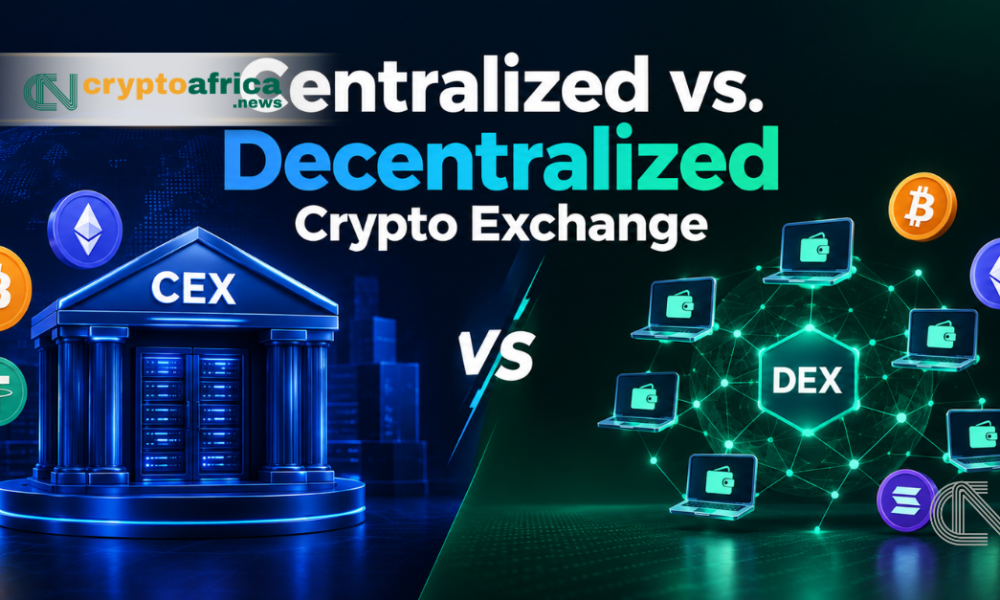
Table Of Content
- Key Takeaways
- What is a Centralised Exchange (CEX)?
- How does a Centralised Exchange (CEX) Work?
- Pros of Using a Centralised Exchange (CEX)
- Cons of Using a Centralised Exchange (CEX)
- What is a Decentralised Exchange (DEX)?
- How Does a Decentralised Exchange Work?
- Pros of Using a Decentralised Exchange
- Cons Of Using a Decentralised Exchange
- CEX or DEX: Which Should You Use?
Key Takeaways
- Centralized exchanges (CEXs) hold your private keys for you, while decentralized exchanges (DEXs) give you total custody of your funds via a self-custody Web3 wallet.
- CEXs act as the primary gateway to convert local bank balances or debit card funds into crypto (fiat on-ramps); DEXs are exclusively crypto-to-crypto platforms.
- A CEX offers customer support and password resets if you get locked out. On a DEX, losing your private keys or seed phrase means your funds are permanently gone.
- While CEXs process over 75% of global spot volume, DEX spot trading reached historic highs in 2026 (~24% of CEX volume), driven by multi-chain expansion and automated liquidity pools.
Once you decide to buy, trade, or hold crypto, you also have to decide where to buy it. A simple search will give you several exchanges. But how do you know which one is right for you?
This guide explains centralised (CEX) and decentralised exchanges (DEX), their features, and how they differ. It also explains the associated risks of CEX and DEX to help make an informed choice.
What is a Centralised Exchange (CEX)?
A centralised exchange is a custodial platform owned and operated by a company. The company acts as a broker to help you buy and sell your cryptocurrency.
Examples of centralised exchanges include: Binance, Bybit, OKX, Luno, VALR, Busha, e.t.c.
How does a Centralised Exchange (CEX) Work?
Typically, to sign up for a CEX, you create an account with an email address, set a password, and verify your identity through standard Know Your Customer (KYC) checks.
You deposit money; the exchange holds it in its own company wallets, and its internal system matches your buy and sell orders against everyone else’s. You get a polished app, customer support, and the ability to buy crypto directly with your local currency.
Pros of Using a Centralised Exchange (CEX)
- Beginner-friendly interfaces: Most CEXs offer an interface and dashboard that feels easy to use, like a typical bank app.
- Customer Support: Centralised Exchanges typically have dedicated customer support to help with transaction issues and account recovery.
- Fiat On/Off-Ramps and Fast Trades: CEXs allow users to deposit with bank accounts and cards. They can also easily convert their crypto back to their local currency when they want to withdraw.
Cons of Using a Centralised Exchange (CEX)
The downside of using a CEX is that the exchange holds your private keys. This means if the exchange gets hacked, goes bankrupt, or freezes accounts, you risk losing access to your funds. Your funds are only as safe as the exchange holding them.
What is a Decentralised Exchange (DEX)?
A decentralised exchange (DEX) is a peer-to-peer marketplace where users trade cryptocurrencies directly from their own digital wallets using self-executing smart contracts. Unlike a centralised exchange, decentralised exchanges do not rely on a company or intermediary.
Some examples of decentralised exchanges include Uniswap, PancakeSwap, and Hyperliquid.
How Does a Decentralised Exchange Work?
Instead of human administrators or some company’s internal system, automated smart contracts match buyers and sellers directly on the blockchain. Unlike a CEX, a DEX does not require you to create an account or upload your ID.
DEX uses a system called an automated market maker instead of the traditional order book. You connect your own non-custodial wallet and trade directly against a pool of funds, called a liquidity pool. Ordinary users (known as liquidity providers) fund these liquidity pools. Liquidity providers deposit token pairs into the pool in exchange for a share of the trading fees.
Instead of waiting for a matching buyer or seller, the DEX uses mathematical formulas to instantly calculate token prices based on the ratio of assets available in the pool. When you execute a swap, your tokens are instantly sent from your wallet into the pool, and the purchased tokens are sent into your wallet.
Pros of Using a Decentralised Exchange
- Full Ownership: Unlike a CEX, where the exchange holds your funds and private keys, a DEX lets you retain full ownership of your funds at all times. This eliminates the risks of a third party holding your funds or keys. You do not have to worry about the exchange getting hacked or going bankrupt.
- Better Privacy: Because you don’t have to upload your ID or complete account registration steps, you can trade pseudonymously. It also means you do not have to worry about your personal information being compromised if an exchange is hacked or breached.
- Variety: DEX allows anyone to create a liquidity pool for a new token. This gives you instant access to a wide range of new Web3 tokens.
Cons Of Using a Decentralised Exchange:
- Higher learning curve: Using a Decentralised Exchange requires you to have at least basic knowledge of how blockchains, networks, gas fees, and wallets work. You also need to learn how to identify potential scams and rug pulls before using a DEX.
- Full responsibility: DEX offers no customer support. That means if you have password or transaction issues, there’s nothing to do. If you lose your seed phrases or private keys, they’re permanently gone.
- No fiat ramps and higher costs: you cannot use a DEX to buy crypto with cash or local currency. You need to have crypto already. Transaction speeds can be slower on DEX than on CEX, and gas and network fees, plus slippage, can make them more expensive.
CEX or DEX: Which Should You Use?
How experienced am I? And what’s important to me? Ask yourself these two questions before you decide.
Start with CEX if:
- you’re a beginner. You have little to no interaction with digital assets, exchanges, or Web3 as a whole,
- you want a way to purchase cryptocurrency or tokens using your bank account, card, or local currency,
- you want a familiar interface and the safety net that customer support provides.
Use DEX if:
- you’re already familiar with cryptocurrency, wallets, and the blockchain,
- you already own crypto,
- you’re comfortable with being responsible for your funds’ safety (scam and rug pull prevention) and your private keys,
- you’re big on privacy and personal data protection,
- you want to explore Decentralised Finance (DeFi),
- you’re interested in tokens not available on major crypto exchanges.
For most newcomers, the safest path is to start on a regulated CEX to make your initial purchase, then learn the fundamentals of Web3 and self-custody before exploring decentralised exchanges. DEXs are worth learning, if not as a replacement for those already familiar with CEXs, but as a second tool.